Monday, September 15, 2025

Learning about AI in the Elementary Classroom: A Hands-On Project


September 15, 2025


Interactive exercises help make artificial intelligence (AI) much easier to understand. In Project 2: Training Data and Machine Learning from Hands-On AI Projects for the Classroom: A Guide for Elementary Teachers, students in grades K–5 explore AI concepts using picture cards to organize and sort data (Black & Brooks-Young, 2020, p. 20). Students can use the cards to demonstrate how AI "learns" from datasets, giving concepts like data and algorithms a more real and approachable form.

Learning important terms like algorithm, bias, and dataset is the first step in the project (pp. 20–21). Next, in order to mimic how AI organizes information, students group picture cards into categories and subcategories. They then make sure that all cases are included and that everything that doesn't belong is eliminated in order to check for bias (pp. 24–25). In order to illustrate how AI systems learn from organized information, students lastly develop rules for adding new data. These tasks teach fundamental AI ideas while developing problem-solving, critical thinking, and teamwork abilities.
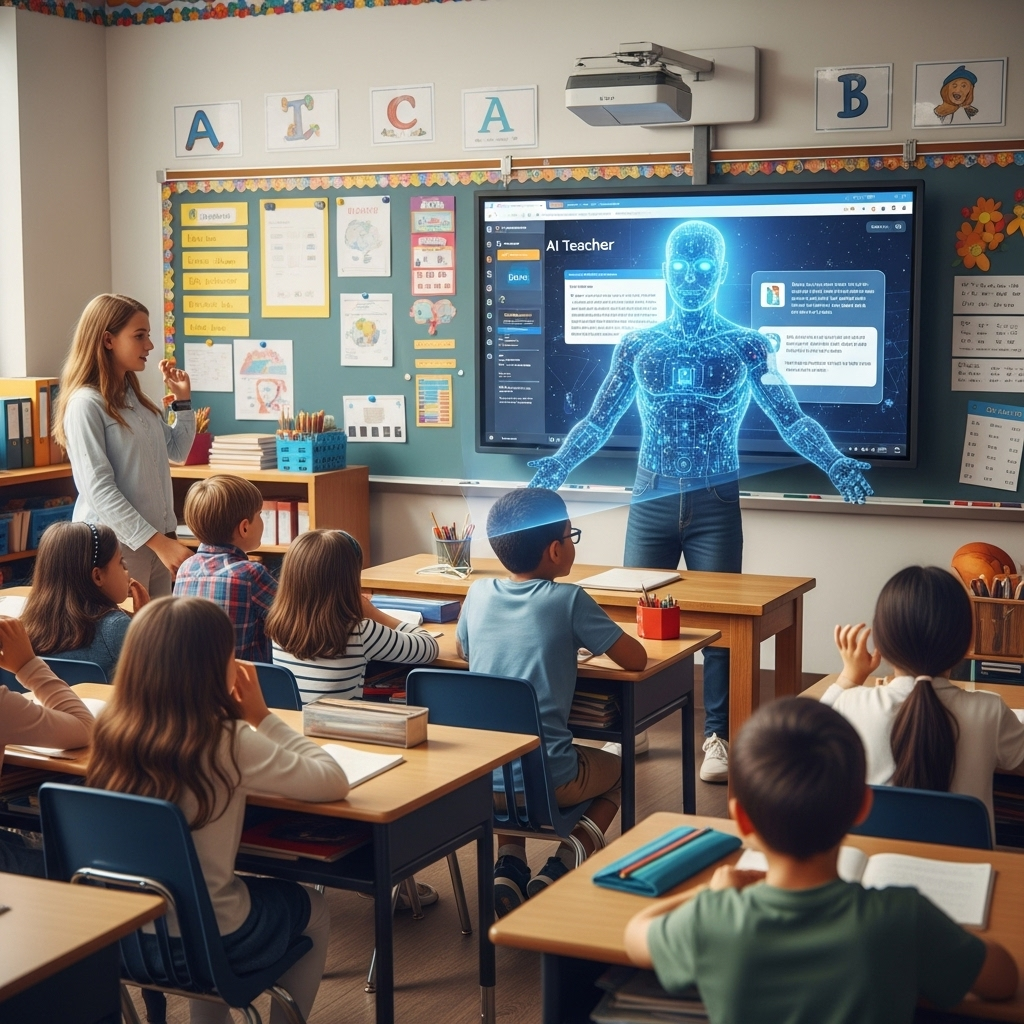
AI Elementary School Teacher in a Diverse Classroom Setting | AI Art  Generator | Easy-Peasy.AI 


This experiment shows that AI may be applied across subjects and understood at an elementary level. Google's Quick, Draw! is used in Activity 2 to demonstrate how AI can identify patterns, offering a real-world illustration of machine learning in action (p. 24).In addition, students understand the value of data organization and verifiying skills that extend beyond AI courses. All things considered, the project develops cognitive thinking and reasoning abilities while providing an interesting, practical introduction to AI.


AI and Art

 Using Ai to Create Art

   This post is in response to the book, "Hands on Ai projects for the classroom: A guide for Elective Teachers." More specifically Project 3, which can be found on page 26. The project suggests examining different art styles across the industry, and then using Ai to create with these styles. They will explore different styles, compare and contrast them, as well as create some pieces of their own. It is aimed to be a very open ended assignment and experience in the classroom. 

I decided to some exploration myself wondering into a internet rabbit hole of different styles and known artist that have left their mark on the world. The possibilites are infinite and at your finger tips when you can use any type of description to create a piece of work. You can tell AI to make a crab made out of recycled materials, or paint a portrait as yourself as if it was Da Vinvi. These obviously are not the same as an artwork you can hold, but it supplies students and anyone else with the ability to imagine what those historic artists could be creating today. Or to show you how something may look and turn out, before pouring hours of work into it.

Here is the picture I created with ChatGPT. My promst was "create an image of a guy surfing in a tropical area but make it look as if Vincent Van Gogh painted it."


It is highly debated whether or not Ai has a place in art or if it just a rip off knock off. I for one think it does belong within the industry. As long as credit is not being taken for something that was made by AI, then there is no issue. It is simply just another style of work to add onto all the rest. It is the opposite of what modern day art has become, today it is all about the process of creating, though by using AI, you can skip the process and have any result you want right at your finger tips. Below is a video by the Museum of Modern Art, exploring this themselves. 


Importance of Teaching AI in K-5 Classrooms


 Monday, September 15, 2025

The Importance of Teaching AI in K-5 Classrooms


As technology advances and many students find themselves in a classroom setting, the use of AI is a topic many educators are questioning. Artificial intelligence is described as a computer system that allows for problem solving and decision making. Some examples include Snapchat Ai, ChatGPT, and so many more. Teaching AI to young students has a few positives, but come with some negatives as well!

First, while teaching the use of artificial intelligence through early education can show students the benefit of citation, using for an extra hand on an assignment, or even just to get an idea of brainstormed ideas, AI goes beyond that. AI leads to many issues including non original texts and even the suspicion of plagiarism. 

Harvard Graduate School of Education is a perfect use and provides many reasons as to why students should and should not use AI when working. The big question, are students really learning and engaging through AI? Professor Ying Xu exaggerates, "Xu shares what we know so far about how AI impacts children's development and the importance of AI literacy." Read more here. 

Chapter One, Page Four of the EdTech in classrooms K-5 book writes a few reasons as to why AI with young students is a great way to explore beyond their knowledge.

  • "Think in mini lessons; breaking down lessons and adding activities helps make learning more digestible and creates a new opportunity for new information," (Teaching and Learning with EdTech, Page 4).

  • "Make connections; Kids never want to rewrite their work, but when they have a robot on the floor and it's not moving, they want to get it right. Think of it like a code," (Teaching and Learning with EdTech, Page 4).

  • "Allow time to explore; Setting students on their own time to learn and explore. Then the teacher creates a lesson on what they've learned and explored," (Teaching and Learning with EdTech, Page 4). 
This allows for students to have the opportunity to explore their own types of lessons and web tools without the use of AI. While artificial intelligence is a beneficial use for students around the world, it doesn't let them explore and find their best ideas as the computer is doing it for them. Studies show that students in the classroom should use their knowledge and brain and only use AI to cite the correct way and not use the ideas from the computer. 


By Jocelyn Bassi, September 15, 2025

Uses For Ai In Classrooms

    AI in the classroom may present itself as a questionable addition; however, it is an increasingly large part of our society and the educational sphere should welcome and learn to navigate such tools. Not only is it our responsibility to teach learners about the pros and cons of AI so they are better equipped when they inevitably access it, but we must also show them how to ethically use AI and cite it should they use it. AI is a part of our societal fabric and with each passing year I feel as if its presence grows it's evolving faster than we can keep up, but we need to be prepared for the evolution.

Moreover, integrating AI into the learning environment gives educators an opportunity to show students how this technology works instead of exposing them to it as just another unknown object. As cited in Hands-on AI Projects for Elementary Classrooms, even the most simple lesson from a voice recognition challenge to an image sorting task or navigation activity can help students bridge the gap between daily life and unfamiliar concepts. Once they're exposed to AI through these types of lessons, they understand things that AI can do but also things that it cannot. Moving beyond abstract concepts allows students to critically assess technology with which they've already been familiarized.

Furthermore, being involved with classroom lessons provides students with the ability to develop their own AI-based resources instead of simply being users. When educators focus on student-centered lessons, their involvement in development, assessment and testing is inevitable. For example, students can create a basic binary tree to classify images or determine how varying information input could change a result. These lessons not only foster transferable skills such as problem solving, critical thinking and ethical considerations, but also provides them the understanding that they can thoughtfully control AI uses and creations moving forward. This will inevitably help them in any future career path or community engagement when they find themselves surrounded by AI integrations.


Edtech for the K-12 Classroom; Five ways the Pandemic Improved Equity for Students.


The COVID-19 pandemic showed how unequal access to technology is in education. When schools closed in 2020, some districts paused remote learning or gave out devices to help students stay connected. But getting online was just the start—educators also had to support students with special needs or difficult home lives. While there’s no perfect solution, the pandemic highlighted ways to make learning more fair and flexible for everyone.

1. Free Wifi. 
During the pandemic, wifi and hotspots were given out for free. Parents and teachers should continue to encourage this discount/free support to people who truly could use the break. 

2. School Bus Fleets. 
Some districts delivered food to students during the pandemic, as well as free wifi and library books. This was also a way for the school to stay in touch with families who needed it most. 
The Ebook on article 2, page 37, it states "Delivering those meals provides a safe and distant touch point."d distant touch point. “Delivering those

meals provides a safe and distant touch point

BusBoss: School Bus Safety Plans & Best Practices

3. Public Television. 
A school district in Los Angeles paired up with a public TV station to run educational programs from 7am-7pm during the pandemic. Each station made their content based on certain age groups. The ages ranged from elementary to high school and everything in between. The strongest quote from this whole article is "...learning doesn't stop when schools shut down." 

4. School Buildings.
Some families from certain districts would access the districts wifi by sitting in the parking lot of the school. Technology teams even went as far as jacking up the wifi signals so it could be more easily accessed even from inside of cars. 

5. Old-fashioned Paper.
Some students simply cannot work online. Whether that be from wifi issues, or another issue. One school district handed out both paper and electronic learning toolkits. 


Teaching in the Tech Era

Technology is everywhere, and over the years it has integrated itself into the education system. For some of us—especially at the college level—this wasn’t anything new. But when COVID hit, many teachers and students had a huge wake-up call. Practically overnight, schools shifted from face-to-face classes to fully online learning. Technology has completely changed how we learn today.

In Edtech for the K-12 Classroom (Second Edition, Chapter 1, Article 1), sixth-grade English teacher Laurie Guyon shared her experience of using technology for the first time. She admitted she had never touched the device before but quickly realized its potential:

“I kind of fell in love with it,” she said. “From the first moment we did something on the iPad, I saw a higher level of engagement from students. There was a deeper learning that I started to see happen. I felt like it opened up more of the world and allowed some opportunities I would never have tried in the classroom.” (Krueger, pp. 2–4)

Her story shows what many educators have discovered—technology can spark deeper engagement and create opportunities that might not otherwise exist. At the same time, learning alongside technology comes with its fair share of challenges. The good news? With the right mindset, teaching with technology doesn’t have to feel overwhelming. In fact, it can open doors to creativity, collaboration, and meaningful learning experiences. Here are a few tips to make the most of it.


Embracing Technology Together

Technology is always changing, with new tools popping up every day. Sometimes it feels overwhelming—like it might be easier to stick with what we already know. And that’s okay! In fact, it can be the perfect chance to learn alongside our students. When students get the opportunity to take the lead in their learning, they often become more motivated and engaged.

Break It Down

One great approach is to break lessons into small chunks. Try using mini-lessons followed by a quick quiz or even just a couple of multiple-choice questions. This helps students process new information while it’s still fresh. Learning in short bursts keeps things interactive and allows for quick check-ins before moving on. Think of it like learning in “micro-sessions” rather than trying to absorb everything in one long stretch. 

Make Learning Connections

Schoolwork can sometimes feel repetitive, but making connections to real-life situations keeps it interesting. For example, one teacher shared a story about using a nonfunctional robot in class. Students worked on fixing its system until it finally worked. The same idea applies to writing: a rough draft is like the broken robot, and editing is the process of fine-tuning until it’s ready to go. When students see learning in action, it becomes more meaningful—and fun.

Final Thoughts

These are just a few simple tips to help educators and students make the most of online learning. Technology isn’t slowing down anytime soon, and it’s changing the way we all learn. As educators, the best thing we can do is stay flexible and open to growth. And the good news? We don’t have to do it alone—we’re all lifelong learners, learning together.

AI as an Elective


Design, Build, Reflect: AI Elective Projects That Transform Student Learning

Consider students in a graphic design class creating not only layouts, logos, or videos. They may be working on AI applications that adapt their design based on audience preferences. Students in media arts may be writing chatbot or virtual assistant dialogue to incorporate into their stories. These sorts of projects don't merely demonstrate to students what AI can do, but also how and why it does it. They also foster ethical thinking, problem-solving, and transferable skills across subjects. AI is becoming the new way of teaching and learning globally and is transforming the way the world thinks.

Why it's Important to Teach AI

AI shows a different side of things with a computer input that does research for you. AI is an evolving source of knowledge that the new generation of K-12th-grade students will need to learn to be successful in today's society. For instance, on page 6 of the book Hands on AI Projects for the Classroom, it says that creativity demands human input, but to get a career in certain fields, you will have to incorporate AI into your work to some degree. This means high schools and middle schools should offer AI workshops as an elective for kids to get a jumpstart on their career with learning AI.

Driven Approach

Students will need to learn how to use AI as its continuing to grow throughout the world, but there are ways to teach it. It's smart to start with lectures and videos, but before you get to that point, you have to start with unplugged activities, as stated on page 7 of the book "Hands on AI Projects for the Classroom."This is a way to teach it while doing fun activities as presentations, artwork, and research projects. Teaching AI in classrooms would also be a learning curve for professors and teachers as well; it's still a fresh piece of technology that is growing every day. As you find ways to expose it in the classroom will help teachers learn AI as well, and it will help teachers create new ways to teach it.

7 Essential Accessibility Tools Every Student Should Know

Accessibility tools aren’t designed just for students diagnosed with disabilities; they are for anyone who wants to improve their learning c...