Sunday, October 12, 2025

How I use AI


    As time goes on the more advanced our technology is getting. We now have AI or 'Artificial Intellegence'; that can answer questions, make pictures, or even have a conversation with you. While musing it is also one of the most helpful things made with technology as is collects data from hundreds of sources to supply you with an answer in seconds. AI is also now a helpful tool in classrooms but can also be an overused tool to students.
    I personally use ChatGpt for fixing my punctuation or refining my emails to make it sound more professional. As a student I also use this for studying and asking questions to its chat to see what it tells me. Now since it grabs varius resources some of the answers will not be fully correct so in no way shoould you fully rely on this but its still a very helpful tool.         

 AI is also improving all the time as images last year were clearly AI as they had mistakes in how many fingers a person had or which way the eyes were pointing. AI now can reate videos that are seamless and can make it look like actors playing a scene out. With AI in the future it can be some of the most influential and teachable things in history. AI is not a teacher though and a personable experience in a classroom which is the only thing it cant fully replicate. I believe that AI is going to be an amazing tool for students to learn when AI becomes more of a teachable web page but for now students have no guide to what to search for it to be educational and not just the answers without guide. 

        AI can be an influential tool for students to learn and be taught. As of right now though AI has not been perfected and students still can use the tool with too much of an advantage. In time though this tool can flourish into many amzing tools for students and teachers where students can only get information and cannot get direct answers to questions.

Saturday, October 11, 2025

AI Use & The Future

    AI is growing more and more prevalent as time moves on. My first experience with AI was in my sophomore year of high school as ChatGPT released to the public. Nowadays, I use AI in my personal life for creating generated images and audio clips for leisure projects. In school, I use sites like NotebookLM to give me inspiration for what my assignments could like. For example, it can help me with how to start a project or give me grammatical help for writing assignments. AI can very beneficial at times when an assignment seems confusing or lets you see it in a different way. 
Accelerating Climate Modeling with Generative AI
    AI can help students learn more effectively in the class by giving feedback on the work they've created. It can also help teachers with their job like aiding them while creating the curriculum and creating questions students can answer. But, everything has their pros and cons. For AI, students may become too reliant on the tools and not learn to have creative freedom and do things by themselves. The more we use AI, the more it learns and becomes better at the task. There will always be worries of AI taking over, but overusing it will not help things get better. 

    In the next five years, AI will most definitely be a part of the classroom and a tool for education. My guess is softwares like Google Classroom and Blackboard will integrate AI onto their platforms like a chatbot where you could ask it anything academically. For educators, AI can be used as a tool to help grade assignments and projects. In the future, challenging can occur like not knowing what is AI or not. Students might not be able to think critically with what they are given. The importance of asking questions if things are real or not must also be taught during this stage of AI.
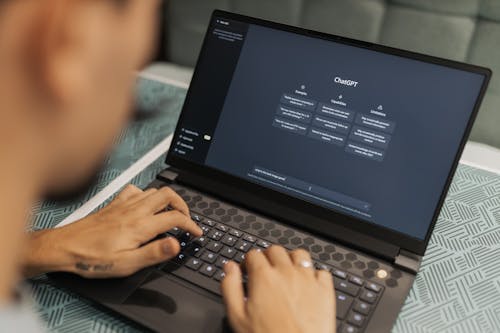
Chatgpt Interface Photos, Download The BEST Free Chatgpt Interface Stock  Photos & HD Images
    In the future, I hope there will be a way where creative freedom and AI can work hand-in-hand in the classroom instead of taking over the human psyche. Responsible AI use in the future is a must for this tool to be ethically and morally right. This includes being transparent about AI usage and doing your own research. Overall, AI will keep growing as a helpful tool in education, but it is up to us to use it the right way so we don't become obsolete in the future.

Embracing AI in Education: Reflection, Impact, and the Road Ahead

 Artificial Intelligence is no longer a thing of future imagination, it's here shaping how we learn, teach and engage with each other. 

My current AI use 

Over the past couple of years, I have mainly used two AI tools, namely ChatGPT and Copilot. They have both assisted me on my educational journey and otherwise. As a student they helped with breaking complex issues into bite sized pieces that is easier to understand, and these tools are my go-to for generating practice questions when studying.

Benefits and challenges

The ease with which information is right at my fingertips is a plus, it is like my personal assistant. However, the overuse of these technologies can cripple original thinking. There is also the issue of accuracy where AI generated content can sometimes include errors, therefore one has to be very careful and double check finished work.

AI and Educational Practice

AI tools have incredible potential to support students, teachers and schools.                                                                 

  • For students they offer a personalized point of view allowing for real-time feedback and tutoring which can be readily available.

  • For teachers AI can easily create lesson plans, automate tasks like grading assignments and give feedback on students' performance.                                  

  • For schools AI can assist with administrative duties, 

With the introduction of AI tools in education we must be prepared for the risk of bias which can unintentionally reinforce stereotypes.  Data privacy is another issue that we must be concerned about – how student’s data is stored, collected and used must be secure and transparent.

Looking Ahead: The Next Five Years

I can see AI becoming so intertwined in education, so much so that students will have access to personalized platforms that fit their needs. AI-powered tools will support real-time language translation, enabling more inclusive, multilingual classrooms. Teachers will be able to step in and support students who are falling behind by using AI tools to examine learning challenges. However, there might be challenges as it relates to affordability, the gap could widen if access to AI tools is limited by one’s financial status. 

My Vision: A Responsible Relationship with AI


I would like students and teachers to use AI responsibly; teachers will have to lead by example in this regard. Students should be encouraged to use AI to ask more questions, explore and experiment more. Schools have their part to play in ensuring that AI is easily accessible to all students.


My Use of Ai:

My Current Use of Ai:   
 I just recently learned about Ai, so I am very much new to it. I only started using Ai to help me with everyday questions or concerns, finding it very much helpful. The only Ai tool that I use is ChatGPT. I have used it as a student and as well as an everyday person that wants to learn something new. A benefit that I have noticed when using Ai is finding answers are so much quicker, I love the fact that I don't have visit a thousand websites or go through different paragraphs to find a single answer. A challenge that I have noticed when it comes to using Ai is that sometimes the information that I am given is incorrect, however, I just do a bit more research to find the correct information. 
Practice Between Ai and Educators:
    I see Ai being used and supported by learners, educators, and schools more often in the future, I truly feel like Ai will help assist education a better learning experience. Data privacy is something that I am concerned about, since Ai is everywhere, who goes to say that it doesn't know stuff about us and collecting data about us. 
Looking Forwards for Ai:
    I imagine Ai will influence education in a good way, giving us more information, quicker and less time consuming in the next 5 years. A challenge that I hope doesn't happen is putting teachers out of jobs, although Ai is very helpful, I just hope it doesn't affect pay and jobs for teachers. 
My Vision:
    I hope educators and students will have a positive relationship with Ai, especially since it makes all of our lives so much easier and stress-free. Ai can be use to promote creativity, critical thinking, or equity, by providing examples or ideas. Sometime when I am doing an assignment and I don't know how to start it or what it is about, I ask ChatGPT for help by providing examples or ideas to help me how to attack that assignment. 

Wednesday, October 8, 2025

My Relationship With AI

 ChatGPT expands reach as new features ...

I've used AI as a student, since my second semester of College.  My primary AI has been ChatGPT.  At first, I used ChatGPT to help me with coding, for my Programming with Python class.  From the very beginning, I could tell that ChatGPT should always be taken with a grain of salt.  It had a bad habit of adding certain programming words I didn't know, and that I knew would likely make the professor suspicious if he looked at them.  That's why I tried to make the code first, before I had ChatGPT fix it.

The following semesters, I made sure to use ChatGPT as nothing more than a tool to assist me, when I really needed it.  For example, one time I missed an essay, and had ChatGPT create a framework for me to base my own essay on.

Then I took a class on AI over the Summer, and was forced to pay for GPT 4o.  With GPT 4o, I made a GPT of my own, and got played around with an image generator for the first time.Sora 2 is here | OpenAI

I can see AI supporting educators by functioning as a tool for organizing tasks, grading assignments, and helping students practice technical skills like math.  However, it must not be over relied on, because an AI can not teach in the same way a human can.  AI can also be used as a studying tool for subjects like math.  The AI can generate math problems for students to solve, and show them how to solve problems, when things get more difficult.  

However, like I said before, the AI must also be taken with a grain of salt.  AI is known to have digital hallucinations, making up information it doesn't know was made up.  For that reason, teachers must verify the information the AI presents them, before believing it to be true.  Take the seahorse emoji, for example.  The AI is programmed to say you are right, so it keeps claiming there's a seahorse emoji, only to get it wrong, and look for a new one.

Does a seahorse emoji exist?” : r/ChatGPT

I believe in the future that educators will incorporate ChatGPT into their lessons.  Some teachers will be smart enough to not let ChatGPT completely run the show, but other teachers may find themselves overreliant on the AI, at the cost of educational abilities.  I also believe that rules will be put in place, as they are now, that limit just how much students are allowed to rely on ChatGPT.  We want students to think for themselves after all.

Monday, September 22, 2025

Collaboration in Educational Technology: Building Learning Together


Collaboration is a key component to how people learn and solve issues whilst working together towards achieving a common goal. In education, collaborative learning strategies help students not only gain knowledge but also pick up crucial skills such as teamwork, sharing ideas, understanding and connecting with each other. Through collaboration they also learn how to solve problems. When coupled with technology, collaboration can be a powerful tool.

Why Collaboration Matters in Educational Technology 

  1. When students collaborate, they elevate their thinking by expressing and explaining themselves and they question each other to gain insight for a better understanding.                  
  2.  Skills such as coordinating tasks, giving feedback and using collaborative tools will all be essential to help students navigate the world of work which has become increasingly technological and are sometimes remote, working across different time zones.                         
  3.  Educators also benefit when they collaborate with their peers, sharing lesson plans, helping each other with designing assessments and mentoring each other.

Tool / Type

What It Does

Benefits & Use Cases

Cloud-based document editing (Google Workspace, Microsoft 365, OneDrive)

Multiple people can edit the same document/presentation/worksheet in real time

Good for group essays, peer editing, collaborative research. Speeds up feedback loops Lemonpeak+1

Interactive boards / virtual whiteboards (Jamboard, Padlet, FigJam)

Visual brainstorming and idea mapping; sticky notes, images, drawings

Helps in planning, mapping concepts, group problem solving. Especially useful when students are remote Edcafe AI+1

Discussion / video response tools (Flipgrid, Zoom, breakout rooms)

Students share ideas via video, respond to prompts asynchronously or synchronously.

Builds connection, gives voice to those less comfortable speaking up in class. Good for reflection and peer feedback. Kitaboo+1

Assessment & feedback tools (Wooclap, Peergrade)

Allow peer assessment; real-time polling; interactive question/quiz formats.

Encourages accountability; lets learners see other perspectives; teaches constructive critique EdTech Impact+1

Learning Management Systems (LMS)

Central hub for resources, assignments, discussions, collaboration tools

Keeps things organized; supports blended learning; can integrate many of the tools above  Lemonpeak+1


Overcoming challenges

Collaboration isn’t always a smooth journey, conflicts may arise, or some students might not pull their weight. Teachers can address these issues by setting clear expectations, monitor the group dynamics and provide guidance. Teachers should encourage open communication and respect to ensure that collaboration remains productive and inclusive.

Conclusion

Student collaboration isn’t just a classroom activity, but it

is also a life skill. By working together students learn to communicate effectively, think critically and build relationships that will not only help in their academics but will also help them to thrive in a professional setting.

Sources

https://lemonpeak.com/blog/2024/05/09/shaping-the-future-of-education-collaboration-tools-and-remote-work-technologies-in-edtech/?utm

https://www.edcafe.ai/blog/collaboration-tools-for-teachers?utm

https://kitaboo.com/technology-shapes-collaboration-skills-in-k12-students/?utm

https://edtechimpact.com/categories/collaboration/?utm 


Putting Students First in a Tech Classroom


 The idea behind this is because educators can get so caught up in apps, tools and new technology trends that they forget what really matters the students, who should be the heart of everything they do.

Why Student-Cantered Technology Matters?

The ISTE standards for students aren’t about making students tech savvy but for developing learners to solve real world problems, think critically and how to thrive in a connected world. There are seven student standards:

  • Creative communicators – students who express themselves creatively

  • Global collaborators – those who connect beyond the physical classroom

  • Computational thinkers and innovative designers – they tackle challenges with a sense of confidence 

  • Digital citizens – one who acts responsibly and ethically when interacting online

  • Empowered learners – those who take the initiative and don’t wait for learning to happen, they make it happen

  • Knowledge constructor – students who evaluate and do their research to solve problems

These standards go beyond just merely using technology but seeks to point out how students should engage with knowledge and interact with others in the world.

The Coach’s Role?

Coaches are reminded to use these standards as a means to encourage and support students to meet their learning goals.


7 Essential Accessibility Tools Every Student Should Know

Accessibility tools aren’t designed just for students diagnosed with disabilities; they are for anyone who wants to improve their learning c...